
Displacement transducers, which are also known as eddy current probes or proximity probes are non-contact transducers used to measure relative movement between the shaft and the tip of the sensor. They are typically drilled into journal bearing or sleeve bearing. Hence they are difficult and expensive to install. Proximity probes are very useful in plotting orbit diagram-how the shaft is moving within the bearing when installed 90o apart. Displacement transducers are suitable for low frequency measurement such as in turbine and compressor applications.
A proximity probe consists of three main components: a driver, a probe, and a cable. A voltage is supplied to the driver that produces RF signal. That signal is then transmitted to the probe through the cable. A coil inside the probe tip generates a magnetic field. As the distance to the shaft changes, the absorption of the magnetic field causes the output probe to decrease or increase in proportion to the gap distance.
Velocity Transducers
Velocity transducers are contact transducers, used to measure velocity. They are usually mounted on bearing housing. Velocity transducers are still used in industry to some extent, mostly in condition monitoring such as industrial fans, pumps, etc. The use of velocity transducers has shifted to accelerometers that are internally “integrated” to velocity. Velocity transducers are suitable for mid-range frequency measurement.
A velocity transducer contains a magnet, which is suspended between a spring and a damper. The magnet is surrounded by a coil. As the transducer vibrates, the magnet remains stationary due to inertia. The magnet moves within a coil, which generates electricity proportional to the velocity of the mass. Hence there is no power supply required.
Acceleration Transducers
Acceleration transducers or accelerometers are contact transducers and are mounted on the bearing housing. Accelerometers are the most common types of transducers used in industry for machinery vibration analysis such as angle grinder, electric motor, etc. There are a number of different types of accelerometers. The most common accelerometer is the internally amplified piezoelectric. Accelerometers are suitable for high frequency measurement.
An accelerometer contains piezoelectric material-crystal, which is placed under a load. As the transducer vibrates, the crystal is compressed or decompressed, and a charged is produced. The charge output is proportional to the force, and therefore acceleration (Newton’s second law). An amplifier is required to convert that charge output to a voltage output. In modern accelerometers, the amplifier is located inside the transducer, and is powered by the data collector through DC polarization of the signal. These are known as integrated circuit piezoelectric (ICP).
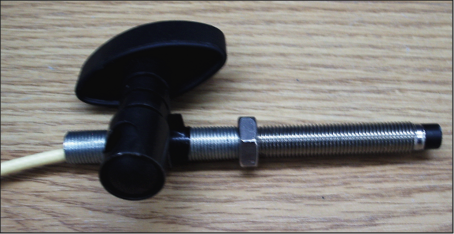
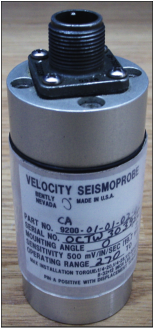
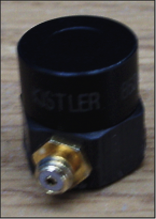
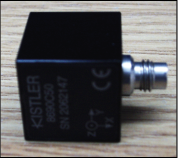
From Top to Bottom: Displacement sensor, Velocity sensor, Single-axis accelerometer, Triaxial accelerometer.