
Cavitation describes the process where a liquid is vaporized due to fluid flow effects to form “cavities” or vapor bubbles; these bubbles rapidly implode and generate immense forces.
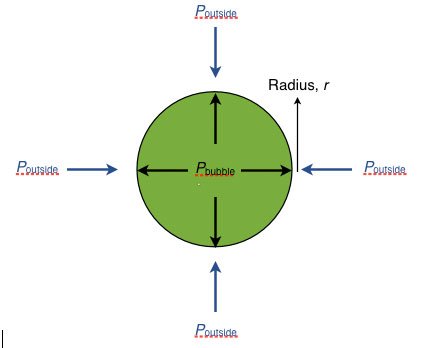
A sudden drop in pressure of a liquid, below its vapour pressure, causes it to vapourize. This phenomenon occurs in applications such pumps and boat propellers were sudden, fluctuating pressure changes can occur near the impeller or propeller surface. When a vapour bubble forms, the vapour pressure inside it (Pbubble) is equal to the pressure of the fluid outside it (Poutside) as shown in the figure below, and it is inversely proportional to the bubble’s radius, r. As the fluid pressure increases the bubble starts to shrink and its radius begins to decrease; this means that Pbubble starts to increase, and it theoretically approaches infinity as the bubble collapses in on itself. When these bubble collapse on the surface of of an impeller, and incredible amount of pressure is exerted onto the blade.
When cavitation occurs, hundreds of vapour bubbles can form and collapse at the impeller’s surface and cause significant damage. Cavitation can cause severe vibration at very high frequencies; it also creates a mass imbalance that leads to additional vibration. A lot of research on fluid dynamics has been done to try and prevent cavitation. Careful design of pump systems and blade profiles can minimize its effects as it is not always completely avoidable.