Determining the cause of vibration can be a complicated task and it is always important to consider the machine which is being analyzed. Vibration can be associated with various sources such as:
- Bearing faults
- Mass imbalances
- Damaged gears
- Loose belts
- Electrical faults
- Hydrodynamic instabilities
Knowing how a machine operates can help you correctly identify the source of vibration. In my previous post I had mentioned synchronous, non-synchronous and sub-synchronous vibration, which are associated with specific vibration sources; peaks from these sources are observed during spectrum analysis and they usually occur at particular frequencies, which are referred to as forcing frequencies or fault frequencies.
As an example, a fan with 5 blades will create a peak in the vibration spectrum at 5 times the running speed, which would be as a result of instability in the air flow. If the fan was running at 1000RPM, a peak in the vibration spectrum would be seen at 5000RPM. This particular forcing frequency is called the blade pass rate.
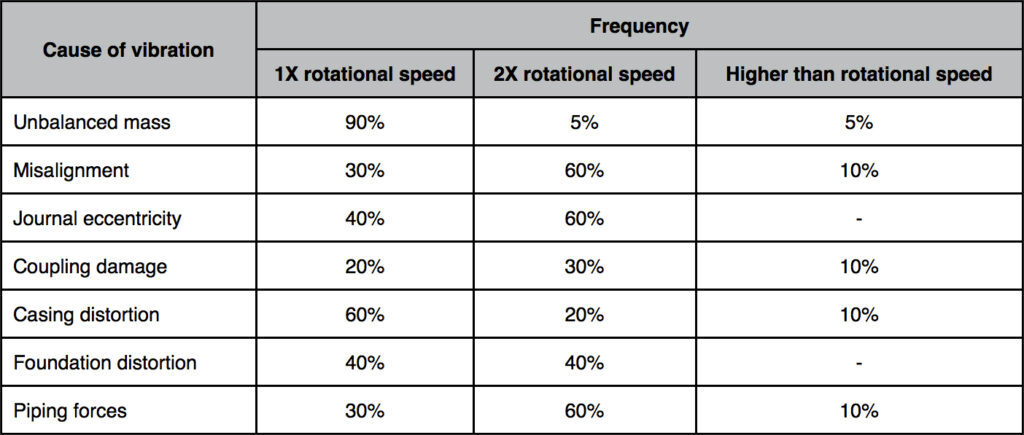
Forcing frequencies are usually related to specific rotating parts within a machine; therefore it is critical to understand the internal components in order to properly identify the sources of vibration. The following table give examples of forcing frequencies and the associated sources of vibration.