
Transducers transmit a continuous analog signal that has to be captured before any analysis or signal processing can occur. It is impossible and inefficient to record every bit of data being transmitted, and data collection hardware and software can be manipulated to take readings of the signal at specific intervals.There are 3 important parameters that have to be controlled in order to obtain useful measurements for analysis; they are:
- Sampling rate
- Sampling time
- Number of samples
The sampling rate is the frequency at which measurements are captured from the sensor or transducer.
The sampling time is the length of time used for taking measurements.
The number of samples refers to the quantity of individual measurements recorded.
The sampling rate, sampling time and number of samples are related as follows:
Sampling rate x Sampling time = Number of samples
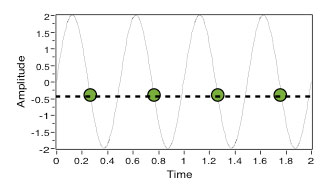
When selecting the sampling rate, the rule of thumb is that it should be 2.56 times greater than the highest frequency that you want to measure; this is known as the Nyquist Frequency. Sampling at a rate higher than 2.56 times the maximum frequency of interest ensures that enough data is collected to reproduce the original signal. Figure 1 shows that if you sample a 2 Hz signal at a rate of 2 Hz, it will yield a straight line that does not accurately depict the original signal.
For example: if you wanted to record a signal with a frequency of 100 Hz, you would have to select a sampling rate of:
100 Hz x 2.56 = 256 Hz
Controlling the number of samples will determine the resolution of spectral data i.e. it will impact the ability to separate between adjacent frequencies in the spectrum. The resolution is sometimes discussed in terms of the Lines of Resolution (LOR). For a spectrum with a maximum frequency of 1,000 Hz and 200 LOR, the resolution is:
1,000 Hz / 200 LOR = 5 Hz
If the lines of resolution are increased to 400, then the resolution is:
1,000 Hz / 400 LOR = 2.5 Hz
The number of samples and the lines of resolution are related as follows:
Number of samples = 2.56 x LOR